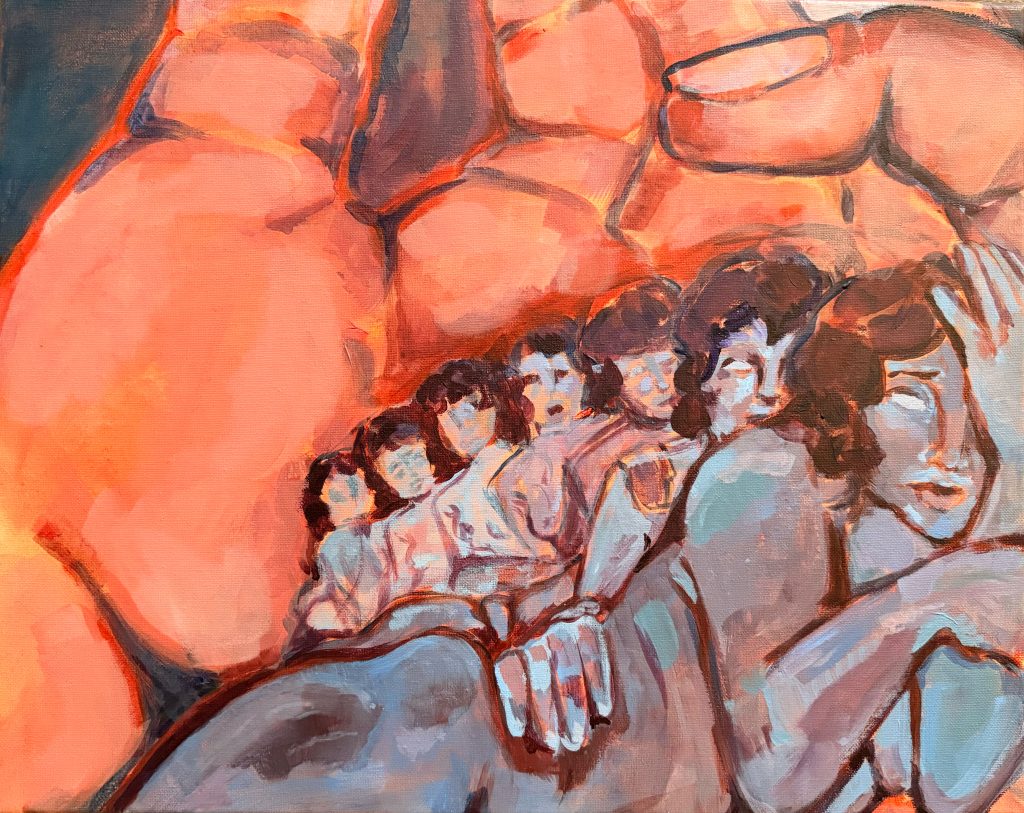
My painting, Held, depicts a series of women, painted in a muted blue. They hold each other, some passionately, some with sexual undertone. Some cradle, while the others remain detached. They get smaller as they move away from the focal point, the first woman, who covers half her face in shame. Each figure’s expression varies: but there remains a duality between comfort and fear. The color palette is not dull, it’s very varied in fleshy pinks and bruised tones (blues and purples). And it aims to be diverse even despite its limitations of the usage of a literal limited palette of only two main pigments [red-orange and indigo]. The figures are being held in the palm of a fleshy pink hand that functions as a greater symbol of oppression, past the self oppression of the women. The painting holds three interconnected themes, even though they all remain separately impactful as well. Early onto analyzing the painting, I wanted the themes of internalized oppression, in terms of womanhood under patriarchy to shine through. The aforementioned hand is modeled after both my own, and of an undisclosed man in my life. It’s representative of both the self and societal oppression women face through existence. This theme is also supposed to be viewed especially regarding non-male-centered sexuality (e.g., sapphic attraction and masturbation). On a deeper look, this painting also aims to discuss the themes of self-comfort and escapism as responses to trauma and stress (especially under capitalism). This theme of self-comfort with the goal of escapism also ties within the discussion of masturbation; pleasure as a source of distraction. Both themes are sourced from a third: the commodification of relationships and emotions, where even intimacy is structured by power and money. Alexandra Kollontai argued that love cannot flourish under capitalism, where marriage and emotional life are commodified. She also exemplifies that a free society is one without the oppression of women: “The economic independence of women is an essential condition for free love” (The New Morality and the Working Class, 1918). This painting visualizes how women’s internalized shame, shaped by patriarchy and capitalism, fragments the self and renders both love and self-love impossible—ultimately illustrating Kollontai’s belief that true emotional and bodily autonomy can only exist outside capitalism.
The painting depicts a woman who is both comforting and recoiling from herself—a visual metaphor for masturbation interwoven with shame. Masturbation here is not eroticized but hidden, shrouded in ambiguity, illustrating both avoidance and craving for comfort. This isn’t a literal masturbation but rather an allegory for the guilt one can feel when it comes to doing anything for themselves. [It should also be noted that I don’t exactly know how Kollontai would feel about my depiction of her ideals. She was famously anti-sex work and this has occasionally been interpreted as anti-sex. However, I think that this dislike of sex work was stringky rooted in dislike of the monotization of womens bodies, rather than a dislike of sexuality itself. “Sexual repression is not just about control—it is about shame. The young woman is taught to feel dirty for knowing herself” (Mendoza, 2014). When I was younger, Mitski’s “Shame” was one of my favorite songs. This song is on a base level about religious guilt and masturbation or feeling pleasure in sex; Mitski feels like she is being watched at all times by a higher power and that she should feel ashamed for this. The song now works as a modern echo of this tension, the higher power watching us is capitalism- and by extension patriarchy. There is an ever present cultural stigma surrounding women, especially when they do anything not directly serving men but are serving themselves, there isn’t any value in existing without directly vying for a man’s approval. It’s shameful if it doesn’t serve the man, and this shame leads to self-surveillance, where women internalize these messages and begin punishing themselves for pleasure. The painting’s copies of the woman are both aggressors and victims—suggesting an endless loop of inner conflict, where seeking solace is punished by internal guilt. Masturbation connects to the labors of coping—self-pleasure becomes self-work under capitalism: it is a moment of escape that quickly folds into guilt or productivity metrics (did I do this too much? Am I okay? Am I enough?) This self-pleasure extends well past the topic of masturbation, and even though the painting is in some way about feminine sexuality, what truly should take center stage is the oppression of women’s comfort. This oppression, however, does not remove the need for comfort, it only adds shame into the action. The shame and guilt found in the means of comfort only leads to an added need for comfort. Addiction to comfort under shame is another underlying theme within this painting, Each figure is caught in a cycle of soft horror; reaching for herself but never fully connecting. These comforts can be found in a number of things, we can be addicted to pretty much anything: Social media, online validation, retail therapy, compulsive behaviors—all modern forms of emotional masturbation that soothe without healing. Late stage capitalism creates hyper-individualized loneliness: “The market tells us we are enough, but only if we buy this lotion, take this break, post this selfie” (The Gazelle, 2024). We have become the products of this system, there is this commodification of pain— even our traumas become profitable content. We are taught to package our suffering for virality, but never resolve it. The reason that we cannot heal is because of this shame, and this shame is because of oppression; the answer here doesn’t lie in removing shame, but rather removing the oppression that causes it. These coping mechanisms are a poor copy of a true freedom, we take the things we’re allowed within a world we lack true autonomy in: “Only in a society without exploitation can love become a true union of souls, not a bargain” (Love and the New Morality, 1918). In the painting, each embrace is uneasy. Love, comfort, and shame are indistinguishable. Capitalism, in the end, teaches us that all intimacy comes with cost.
This painting, while intimate in its framing, functions as a structural critique. It centers not just the bodily experience of womanhood, but the system that codes that experience with shame. Structural oppression—patriarchy, capitalism, colonialism—does not merely exist outside the body. It takes residence within. The painting’s overlapping figures show no clear center—only fragmentation. This suggests that the internal and external forces of control are indistinguishable. There is no clean boundary between what hurts us and what we have learned to desire. Internalized oppression and systemic oppression are not separate but continuous. As Carol Hanisch reminds us, “The personal is political.” The act of self-soothing in the painting, the way the women cradle one another or turn away, shows the feedback loop of social violence. The blue tones that veil them evoke the bruising effects of repression, while the soft red-and-indigo palette suggests both heat and ache: desire and its punishment. From an intersectional Marxist feminist perspective, this dynamic is a direct consequence of capitalist logic. “Capitalism exploits women through both unpaid domestic labor and wage suppression, but it also exploits our emotions and desires” (CADTM.org, 2023). In this light, the painting can be read not only as psychological but as economic. These women don’t just long for comfort; they perform it. Under capitalism, shame becomes a tool of productivity. Women are taught to self-police, stay ‘respectable,’ and conceal pleasure to remain employable, desirable, or ‘stable.’ Their ability to repress becomes a measure of their success. The painting visualizes that repression not as stoicism but as fragmentation: as being held and haunted simultaneously. This psychological toll is not just abstract; it is deeply embodied. The covering of the first woman’s face suggests both shame and surveillance, the kind of visibility that turns selfhood into spectacle. In this way, the painting recalls stories like Ghazal by Daniyal Mueenuddin, where female characters trade autonomy for survival in a rigidly classed, gendered system. As scholar Rizwan notes, “Women often internalize capitalism’s values, accepting their own commodification as inevitable” (2023). The women in the painting do not resist being held; they are not screaming or fleeing. But they are not comforted either. The hand that holds them is modeled after both my own and of an undisclosed man in my life. It becomes impossible to tell whether it protects or controls. In that ambiguity lies the truth of internalized systems of oppression: they feel familiar. Sometimes they even feel like love.
This painting is not about masturbation—it is about the impossibility of loving yourself in a world that profits from your disconnection. Fragmentation, fatigue, and final hope define the emotional arc of the work. Each figure in the painting appears isolated even as they touch, suspended in varying states of retreat and tension. The painting suggests a state of dissociation; from the muted blue tones, and the fleshy pinks, and the echoing gestures of the women. This dissociation is not merely emotional but structural: a response to the internal shame, patriarchal surveillance, and commodified intimacy that govern women’s lives. What is most horrifying is how natural it has all become. Women must soothe themselves, yet feel shame for doing so. This is the cycle the painting aims to capture—the simultaneous necessity and guilt of self-comfort under a society that punishes women for needing anything at all. The self is split between the need for safety and the shame of wanting it. This split is enforced by systems that frame pleasure as indulgence and independence as arrogance. The figures cradle themselves and one another, but their touch is compromised: shaped by what they’ve been told they are allowed to want. They long for love, but that longing itself becomes painful. And yet—there is a final glimmer. This painting is meant to remind us, just as Kollontai meant to remind us, that the future of love is collective. That these painted women (and we as humanity) will never know what intimacy can truly mean until we abolish capitalist oppression. The painting asks us to imagine that future. If the painting shows us brokenness, it also shows us longing. And in longing, there is always a glimmer of what could be otherwise. The figures might be shrinking, hiding, dissociating—but they are also reaching. In their reach is the spark of refusal, of a kind of hope that has not yet been named.